
I’m the kind of girl who has always tried really hard in school and loved learning — ever since the beginning. Something that I especially loved about going to school was taking notes. That might sound a little strange, but it’s true! I find taking notes incredibly relaxing and motivating.
A great friend of mine named Soli actually suggested that I write a blog post about note-taking a few weeks ago. I was so excited to start writing this — and frankly a bit shocked that I didn’t think of it myself!
Although it all comes naturally to me now, there are definitely some tips and tricks that I have learned throughout my years of education that I would like to share. Perfecting my note-taking style has made me feel like a great student and it motivates me to 1. go to class 2. review my notes and 3. start studying early for exams.
I guarantee that if you read my advice on how to take notes like a pro, you’ll feel more motivated than ever to start studying for exams and get your life together! So, what are you waiting for? Listen up… and take notes!
1. Choosing the perfect medium
Before you actually start taking your notes, it’s important to figure out how you’re going to take them. First, think about what you’re learning. Are you in a class where figures and symbols are important, such as calculus or chemistry? In that case, a notebook might be your best bet. Are you in a lecture with lots of words, like psychology or English? You should probably be typing your notes on a laptop.
For handwriting: I recommend keeping a notebook for lecture-style courses, such as chemistry or math. This way, you can write down everything the professor is saying and don’t have to worry about loose pages. For classes where you have lots of handouts, I recommend a binder (high volume) or a folder (low volume).
For online-note taking: I recommend taking notes via Google Docs because it’s great for organization, editing, sharing, and collaborating.

2. Choosing the perfect writing utensils
If you’re writing by hand, it’s important to find the perfect utensil to keep with you all the time. This one can also depend on the course you’re taking. For example, you might want to do math problems in pencil so you can erase your mistakes. I tend to use pens in all my other courses so I don’t have to worry about graphite smearing or appearing faint.
My go-to brand of pen is the Pilot G-2 07. It’s clickable, meaning that you don’t have to worry about caps slowing you down or falling off. Also, it uses fast-drying gel, meaning that smearing won’t be a problem. They come in sets of all black and sets of color, which is super helpful if you like your notes to be colorful — like me!
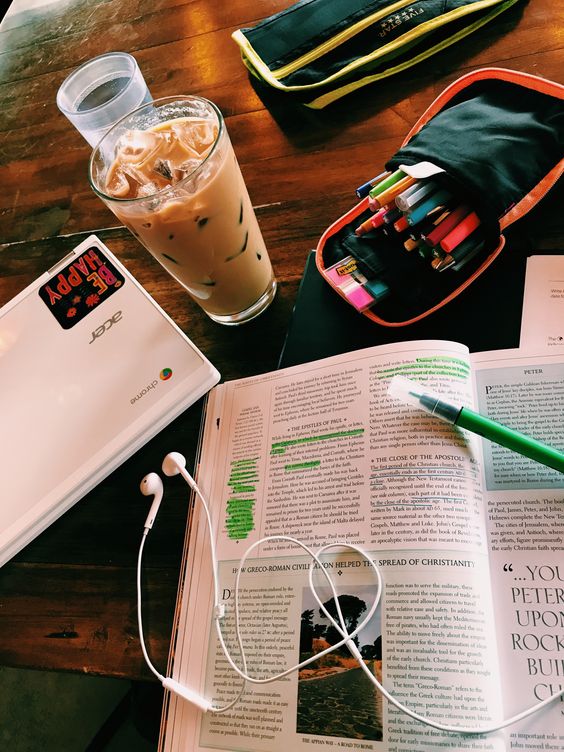
It’s also important to have a set of highlighters on hand, for a few reasons. First, highlighting is really important when you’re doing textbook readings. Also, it comes in handy when you’re writing a title or want to color code a figure.
3. Handwriting
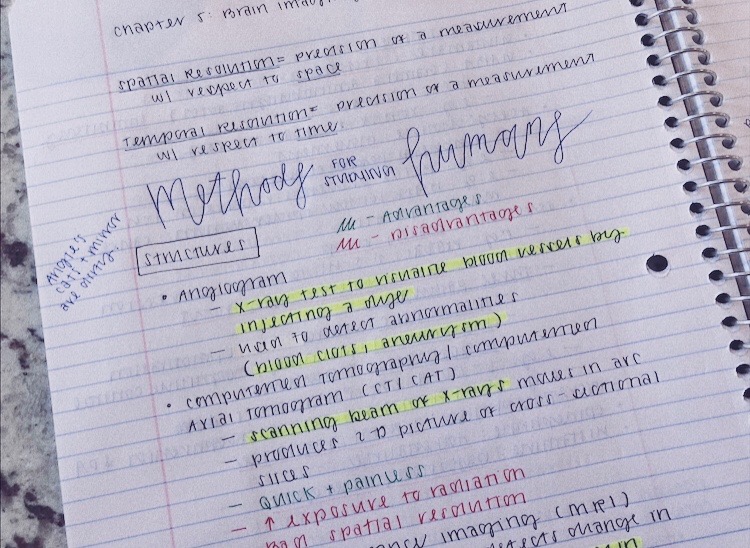
The most important part about having notes that are not only nice to look at but also useful for studying is having neat and consistent handwriting. Good news: If your current handwriting is messy and you want to change it, you can! If you practice it a certain way for a while, eventually it will become second nature.
My handwriting is a hybrid between print and script, which I think is a helpful way to write quickly and stay legible. All of my letters look distinct enough so that if someone is reading it, they know what it reads without much of a problem. The letters still look consistent and neat, however, making my notes look aesthetically pleasing.
4. Organization
It’s important to be able to find your notes when it comes to studying for the exam, so you have to stay organized throughout the semester. When you start taking notes where they don’t belong, it is likely that you will eventually lose them, making it impossible to study well for the exam.
First, keep all of your notes in ONE place. For handwriting: Put each subject in a unique notebook or binder. All your notes for one class should only be in the place you designated for it. For online note-taking: Make folders!! I have a folder for each semester → then one for each course → then one for each exam. Doing so makes it much easier to find your study material when it comes time for the exam.
Next, start every lecture off with a new page and add the date. Label the start of a new chapter or section. This helps to compartmentalize the information and keep it separated in your mind.
Lastly, format your notes like an outline. Outlines are so incredibly beneficial for organizing information, because everything is where it’s supposed to be. It creates a clean, linear path for the information to flow, especially helpful when studying.
It’s important to indicate the start of each chapter or section of your notes. For handwriting: I recommend using dividers or post-its to indicate divisions in your notebook or binder. This allows for quicker page flipping! For online note-taking: Try using the “view document outline” feature on Google Docs, so you can jump to specific sections of your notes easily.

5. Focus on what’s important
During lecture, only write the information that you think is important to know for the exam — and elaborate later. Doing this makes sure that you’re getting the big ideas down first, the details can always be added after class.
Underline or highlight the information your professor says multiple times, because this is probably a clue that it’s important! Sometimes your professor will even state explicitly: “This type of problem will be on the exam.” — Make a note of that! Add lots of stars, circle it a million times, whatever you need to do. That way, you’ll remember to spend some more time on it when you’re studying.
Also: It’s important to write down what’s on the slides, but try to listen to what the professor is saying at the same time. They’re not talking just to hear themselves talk — they want you to remember what they’re saying!

6. Help…the prof is going too fast!
What happens when your professor is moving super quickly through the information and you’re starting to miss out on stuff?
First, calm down a bit. Getting anxious while you’re already in a rush to get information down can make things much worse for you. Simply take a breath and keep going.
Next, if you notice that you’ve missed some material, leave enough space to go back and write it in later. Keep the order! After class, either ask a classmate if they got the information or check Blackboard (if your professor uploads their notes).
A big part of taking effective notes in class is to learn the art of shorthand. Start to think of some words that you can shorten to save both time and space. For example, instead of writing out “___ leads to ___,” use arrows! Abbreviate “information” to “info.” Just don’t get too vague so that you forget what you were trying to say in the first place.
7. Condensing the info
When you’re looking through your notes after lecture, you may feel a bit overwhelmed by all the material. So whether you’re rewriting your notes or making a study guide to prepare for an exam, it’s important to condense all this information.
How do you know what’s important? You should probably keep the defined terms that you don’t know. (If you know it by heart, you can toss it.) You should also probably keep all your diagrams and figures. Images convey much more information than words do.
Also, anything that you can imagine your professor asking you a question about, you should definitely keep — and memorize.

Taking notes is a skill that I take very seriously and that has helped me so much in my academic career. It motivates me to study more when I have nice-looking, organized notes to study off of. It makes me feel like I have my life together.
Plus, I’ve learned how to make it fun! Just turn on some music and jam while you write your notes down from lecture. Try out some new fonts or heading styles. Draw figures that pertain to the material. Then, take breaks to maintain focus.
Try not to view notes as something that you have to do, but rather as a tool that will help you absorb the information. You’re taking these classes for a reason — and paying good money for them — so you might as well get your money’s worth and learn a lot.
So, next time you’re in lecture and you feel bored and unmotivated, try to upgrade your notes a bit. You might find that it makes you feel like a better student immediately!
 the moore the merrier